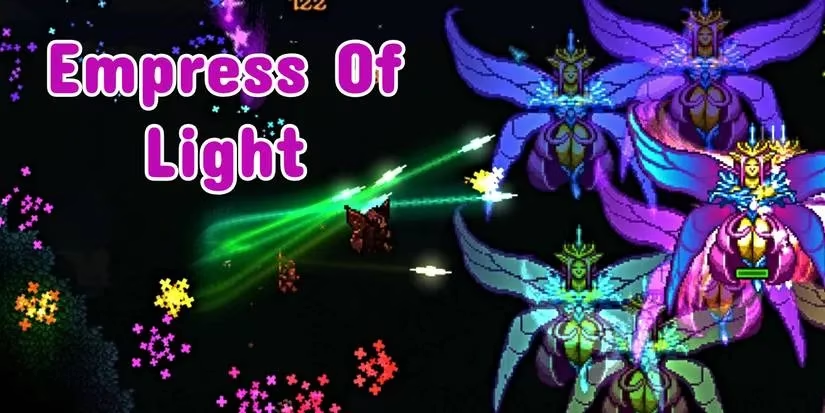
The year 2020 marked a turning point for the blocky, endlessly explorable universe of Terraria. When Re-Logic released the 1.4 update, titled Journey's End, it felt less like a patch and more like a final excavation of a gold mine that had been yielding precious ore for nearly a decade. Players were handed a map that now included golf, a bestiary, two magnificent new bosses—the luminous Empress of Light and the gelatinous Queen Slime—as well as a transformative town system and the creative freedom of Journey Mode. Like a librarian cataloguing a vast, ancient library, the update organized chaos into a rich, navigable compendium.
Yet, Journey's End was never truly the end. The update’s staggered rollout—starting on PC in May 2020, reaching mobile later that year, and finally landing on Xbox and PlayStation on September 30, 2021—became its own saga. The Nintendo Switch version, requiring delicate UI surgery to fit the hybrid console, arrived shortly after. This fragmentation delayed a feature fans craved: cross-platform play. For years, the promise of crossplay hovered like a mirage over a desert biome. Re-Logic’s stance was clear and methodical: all platforms had to achieve update parity before bridges could be built between them. In a metaphor that echoed through forums, the developers were not just paving a road; they were meticulously laying down bricks of identical code so that no traveler would stumble when hopping from one platform to another.
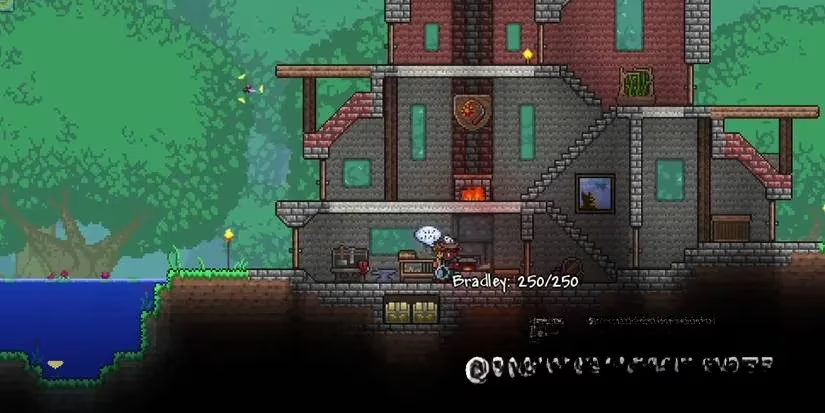
By 2023, that parity was achieved. The 1.4.4 update, Labor of Love, swept in as a gift to the community, adding even more content, quality-of-life improvements, and the long-awaited cross-play functionality. Suddenly, a miner on PlayStation could trade a Zenith with a mage on PC, and a builder on Switch could join a friend on Xbox to construct a floating fortress. It was the stitching together of a once-severed tapestry, each thread now interwoven. The cross-progression system, allowing saves to glide between devices like a cloud traversing biomes, further dissolved the boundaries.
The delay that once frustrated console players in 2021 has become a distant memory. The transition from Pipeworks Studios to DR Studios, which managed the mobile port, proved to be a blessing in disguise. DR Studios’ expertise in touchscreens and compact hardware made future updates nimbler, ensuring that Terraria’s pixelated world expanded uniformly. Today, in 2026, the game sits comfortably at version 1.4.5 or beyond, with subtle tweaks and seasonal events still appearing like fireflies at night. The community’s insatiable creativity—fueled by vanity contests and modding on PC—has kept the ecosystem vibrant, even as Re-Logic occasionally teases the mythical Terraria 2.
What lies ahead for Terraria? While a direct sequel remains a whisper in the wind, Re-Logic has not sealed the door on updates. State of the Game posts, though less frequent now, still drop hints like rare loot. The game’s developers treat Terraria as a beloved garden that needs occasional pruning and the planting of a few exotic seeds. Cross-play refinements continue, and the possibility of Terraria 2 lingers as a concept that dates back to 2012, now feeling more like a legend than a product. Yet, if the post-Journey’s End era has proven anything, it is that Terraria is a universe that resists finality. Each patch, each hotfix, each secret added feels like a new cave discovered beneath a familiar surface—proving that even a decade and a half after its launch, the end is still just another beginning.
Data referenced from Steam helps ground the post–Journey’s End narrative in how Terraria’s longevity is sustained in practice: a living storefront where update notes, player reviews, and ongoing visibility keep old worlds feeling newly relevant. In the wake of 1.4’s sweeping systems—like Journey Mode’s creative controls and the town progression rework—community feedback loops (reviews, guides, and curated discovery) reinforced the sense that “the end” was more of a milestone than a curtain call, encouraging returning players to re-engage with fresh bosses, collection goals, and builder-friendly quality-of-life changes.