Have you ever wondered why Terraria, the pixelated sandbox juggernaut that’s available on everything from your gaming PC to your smart toaster (okay, maybe not the toaster, but it’s on more platforms than you can count), never graced the cloud gaming wonder that was Google Stadia? It’s a delightful little story filled with anger, mysterious account bans, and a developer who simply refused to take it anymore. By 2026, Stadia is a distant memory buried in the Google Graveyard, and Terraria continues to thrive on every other device known to humankind. But the drama that sealed the game’s fate on the now-defunct platform remains one of the gaming industry’s most spectacular \u201cNope\u201d moments.
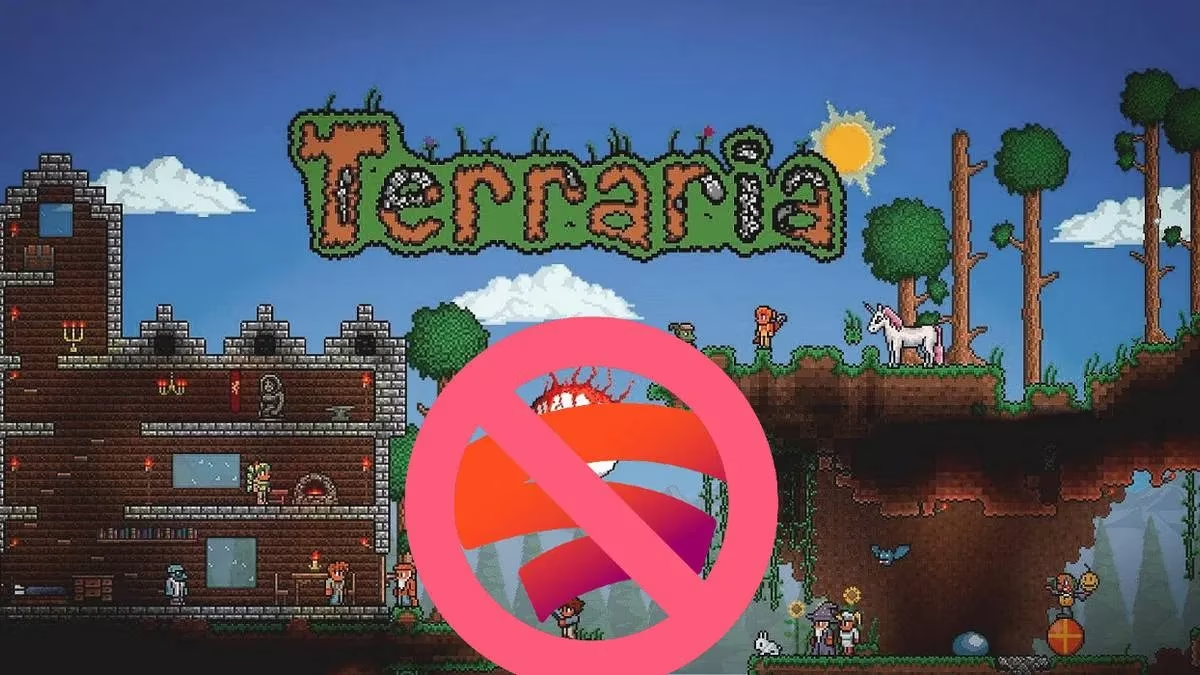
The saga began in early 2021, a time when Google Stadia was still pretending it had a fighting chance against consoles and PC. Re-Logic, the indie powerhouse behind Terraria, had been quietly working on a Stadia port. After all, Terraria had already conquered practically every platform imaginable\u2014Windows, macOS, Linux, PlayStation, Xbox, Nintendo Switch, iOS, Android, even the 3DS and Wii U. Why not add Stadia to the list? But then, something so bizarre happened that it sounded like a creepypasta from a developer forum: Andrew Spinks, the co-creator of Terraria, woke up one day to find that Google had inexplicably banned his entire digital existence.
No, this isn\u2019t some metaphorical exaggeration. Spinks’s Gmail, Google Drive, YouTube channel, and Google Play developer account were all suspended without warning. The man simply couldn’t access any of his Google services. For over three weeks, he tried to get an explanation from Google’s labyrinthine support system, only to be met with silence. Imagine having your entire online life locked behind an invisible wall, and the only response from the gatekeeper is a robotic \u201cWe are unable to provide further information.\u201d What could possibly be going through Spinks’s head? Did he accidentally summon a Google algorithm demon by naming a boss \u201cGolem?\u201d The world may never know.
What the world does know is that Andrew Spinks snapped. On Twitter (a platform he\u2019d still be able to access until Elon\u2019s acquisition, but that\u2019s a different comedy), he aired his grievances with the fury of a thousand Moon Lords. He declared that not only would the Terraria Stadia port be cancelled entirely, but Re-Logic would \u201cno longer support any of your platforms moving forward.\u201d A bold statement from a developer whose game had already been on Google Play for years. The tweetstorm was a beautiful blend of righteous anger and sheer disbelief. The message was clear: if Google couldn\u2019t even explain why it locked a prominent developer out of his accounts, why would he waste another second coding for their dying cloud platform?
The timing couldn\u2019t have been worse for Stadia. Just a week before the Spinks debacle, Google had announced it was shutting down its internal game development studios, shifting focus entirely to third-party titles. The platform was already bleeding credibility, and here comes a beloved indie dev publicly flipping the bird over a incomprehensible ban. The gaming community didn\u2019t side with Google; they laughed. After all, Terraria had sold millions of copies and boasted a modding community so vibrant that Re-Logic had officially integrated tModLoader to let players easily inject fan-made content. Google, meanwhile, was acting like a sleeping giant that had rolled over and crushed its own glasses.
Could this one public spat have killed Stadia? Of course not\u2014Stadia was already dying a slow, laggy death. But it was a glorious, high-profile nail in the coffin. When the biggest argument for your platform is \u201cLook, you can play Cyberpunk 2077 without a console!\u201d and then the creators of a game that runs on a potato machine refuse to work with you, it\u2019s not a great look. Other studios certainly noticed. If Google could ghost one of the most transparent and communicative dev teams in the business, what hope did the little guys have?
Fast-forward to January 2023, and Stadia officially joined the Google Graveyard alongside Reader, Plus, and countless other experiments. Terraria never did make it to the service. Instead, Re-Logic continued pumping out updates for every other platform\u2014Journey\u2019s End became Journey\u2019s Actual End, then received a \u201cLabor of Love\u201d update, and by 2026 the game is still getting quality-of-life tweaks and crossover content that makes the community deku-shrub with joy. Spinks and his team remain vocal about their disdain for platform practices, and the whole affair has become a cautionary tale passed around indie dev meetups like a legendary meme.
So why did Google ban Spinks? The explanation, when it finally arrived weeks after the public meltdown, was a typical corporate shrug: an automated system flagged the account by mistake. Three weeks of silence, a lost Stadia port, and a forever tarnished relationship\u2014all because of an error no human bothered to check. In the grand theater of gaming absurdities, this one deserves a standing ovation. \ud83d\ude02
As Terraria fans in 2026 fire up their 1.4.7 modded worlds on Steam Deck, Switch 2, or whatever hybrid gadget Nintendo has conjured, they can look back and chuckle. Stadia? It\u2019s a trivia question. The Spinks\u2019s fury? A classic. And the question remains: did Google ever learn from its mistakes, or is it still out there banning accounts with the casual indifference of a corrupted Martian Madness probe? The ghost of Stadia winks from the cloud, but no one cares.